
Exercise management principles
Having placed the importance and relevance of exercises in their proper context with the rest of emergency management, we now need to look in more detail at some of the fundamental principles of exercise management.
Activity 4.1
|
 |
Read Reading 14: Extracts from Australian emergency manual: Training management, Chapter 9, paras 9.08 and 9.12–9.22.
|
Exercise management models
|
|
Read Reading 14: Extracts from Australian
emergency manual: Training management, Chapter
9, Annexes B and C. |
The two models presented in the reading may initially look dissimilar. If you examine them closely you will find, however, that they are complementary.
Model A presents a series of six simple and logical processes in exercise management. It also provides some limited outputs to each process. Model B, looks at the process of exercise management from a planning perspective, and provides a suggested time frame in which to design, prepare, conduct and validate two types of exercise. Model B also indicates the need for a policy meeting in the early phase of exercise management. This policy meeting should be the forum for carrying out the need and analysis activities.
The following table incorporates the information from models A and B and demonstrates their similarity. The table forms the basis for the work we will be doing during this Topic.
Model A |
Model B |
Outputs |
Need |
Policy Meeting |
Policy including: Definition of need |
Analysis |
Policy Meeting |
Authority Aim and Objectives Agencies Involved Resources/Budget Select Exercise Type Writing Team Exercise Proposal |
Design |
Progress Meeting (Exercise Writing Team) Co-ordination |
General Instruction General Idea Special Idea Event Schedule |
Conduct |
Exercise Conduct (Exercise Control Staff) |
Briefings Media Releases Command and Control |
De-brief |
De-brief (Exercise Control Staff/Exercise Writing Team) |
Analysis of Exercise - Performance - Objectives - Design |
Validation |
Validation (All) |
Follow up in: - Training - SOP - Exercise Design |
We can also represent this table as a composite exercise management model, integrating the two models into one.
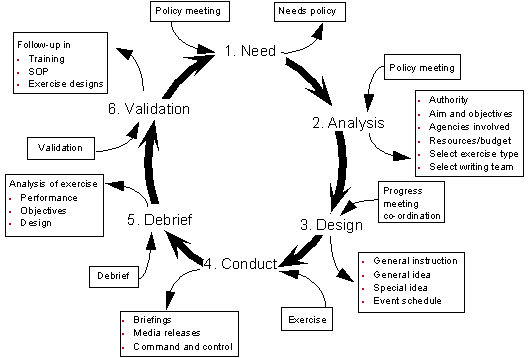 |
Figure 4.2: Exercise management model |
You will not be required to conduct an exercise
as part of your assessment nor be asked to carry
out the validation step. You should, however,
have some knowledge in these areas and they will be discussed later.