Topic 7: Disaster recovery and sustainable development
Introduction
In 2004 the United Nations International Strategy for Disaster Reduction (UN:ISDR) quoted Abramovitz (2001):
Around the world, a growing share of the devastation triggered by “natural” disasters stems from ecologically destructive practices and from putting ourselves in harm’s way. Many ecosystems have been frayed to the point where they are no longer resilient and able to withstand natural disturbances, setting the stage for “unnatural disasters” – those made more frequent or more severe due to human actions. By degrading forests, engineering rivers, filling in wetlands, and destabilizing the climate, we are unravelling the strands of a complex ecological safety net.
Source: The full text of the UN:ISDR is available in two downloadable pdf’s at: www.preventionweb.net/english/professional/publications/v.php?id=657. This quotation is located on page 27, as accessed 3 September 2010.
The human cost of disaster in terms of loss of livelihood, shelter and infrastructure, is a measure of a community’s vulnerability or resilience. For example an earthquake of magnitude 6.5 on the Richter scale occurring in a region with stringent building codes and a high degree of affluence may cause vastly less damage and consequent human suffering, than the same magnitude earthquake occurring in a region with little or no building codes and low resource capabilities. There is a tendency to compare these kinds of scenarios and pronounce the less affluent community “vulnerable”. This is true in terms of physical infrastructure and economic resources, but it may be that the poorer community actually has a great deal more social infrastructure.
Sichuan earthquake in 2008
The 2008 Sichuan, China, earthquake graphically illustrated the importance of consistent planning and policy implementation. Although official policy required building to earthquake standards, the codes were not enforced for many buildings, including schools. As a consequence, these poorly designed and developed buildings collapsed in much greater numbers than those properly designed and built, disproportionately contributing to the very high death toll. Had the existing earthquake building requirements been implemented during the construction of these houses and schools, the loss of life and damage would undoubtedly have been lower (Oviatt & Brett, 2010, p. 54).
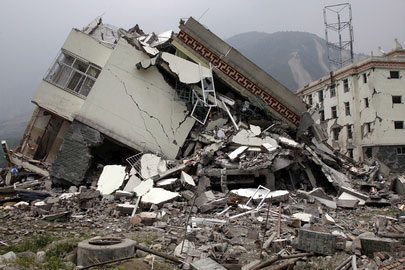
Middle School Building Ruins
Ruins of a Middle School building with children buried alive in the epicentre of the earthquake and an estimated four thousand of the ten thousand residents of the township feared dead
Source: UN Photo/Evan Schneider; 24 May 2008; Ying Xiu Township, China; Photo #178777
www.unmultimedia.org/photo/detail.jsp?id=178/178777
accessed September 2010.
One of the ways in which a community, especially a rural or regional community, can strengthen its likelihood of a strong recovery from disaster is to embrace the concept of sustainable development. Essentially, this requires addressing the causes of poverty, such as inequality between religious beliefs, gender, political systems and so on, to create a more sustainable and equitable community. This is a difficult change to initiate. Rebuilding infrastructure, providing food aid and medical assistance is a much less complicated and immediately visible recovery activity. Humanitarian relief is essential, but it does not significantly address the inequalities in social structure that may exist within vulnerable populations; and these inequalities continue to perpetrate vulnerability to disaster.
Planning for recovery should encompass building community resilience, and closely interlinked with this concept is sustainable development. This is because the temptation is to exploit resources available in vulnerable populations (e.g. mineral wealth, rich crop growing soils), in order to lift the economic situation. However, as we have seen in many parts of the world - for example the Sudan, western styles of deforestation and agriculture can quickly render rich soils into desert landscapes, worsening the situation in the long term. Subsistence farming methods incorporating the movement of cattle, leaving soil to regenerate by lying fallow, and crop rotation, provide an example of the sustainable use of land.
Thus devising a plan which will enhance the economic prospects for vulnerable populations while encouraging a sustainable development of their environment will, in the long term, have significant effects on a community’s capacity to recover from disaster. The objective of sustainable development is to lessen a community’s vulnerability to disaster through encouraging the sustainable implementation of agricultural and industrial techniques which work in harmony with environmental management.

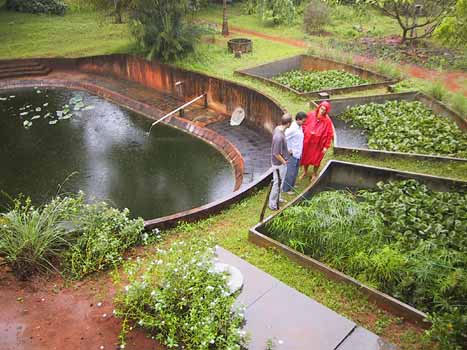
Sustainable development
Source: www.northerntrust.com/.../sustainable-development.jpg accessed November 2010.
In the following Readings the correlation between building community resilience and sustainable development is further examined.
 |
|
|
The 2001 full text version is a free download available at http://www.colorado.edu/hazards/publications/holistic/holistic2006.html The later edition is published as a book for sale. |
|
 |
|
After completing the Readings above, make a list of the strategies that these authors suggest for enhancing community resilience through sustainable development. |
|