
Topic 4: Recovery principles and concepts
Case Study: The Canberra bushfires of 2003
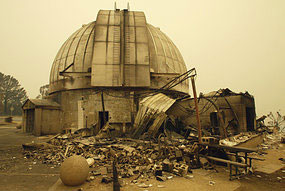
The ANU's Mt Stromlo observatory was destroyed in the 2003 bushfires
Source: Getty Images: Daniel Berehulak; www.abc.net.au/.../05/2646733.htm?site=canberra accessed November 2010.
The following information is directly extracted from the ACT Coroner’s Bushfire Inquiry:
On 8 January 2003 lightning strikes in the ACT and surrounding area caused four fires known as the McIntyres Hut fire, the Bendora fire, the Stockyard Spur fire and the Mount Gingera fire. Eventually these fires combined to produce the firestorm that devastated the ACT on 18 January 2003.
The following information is directly extracted from The Report of the Bushfire Recovery Taskforce – Australian Capital Territory October 2003:
On 18 January 2003, the ACT experienced an unprecedented fire disaster causing the tragic deaths of four people; the loss of almost 500 homes and some 93 community, commercial and farm buildings; damage to many other homes and businesses, including rural properties and villages to the west of Canberra; and widespread destruction of forests and the environment generally.
Few people within the ACT have not been affected by this disaster. During the emergency more than 5,000 people were evacuated to emergency centres. Many others went to the homes of family and friends. Thousands of people participated in fire fighting activities, and in assisting those in the ‘front line’ of the disaster, as neighbours, volunteers and contributors of goods, services and financial support. In the two weeks after the fire, more than 1,000 volunteers came forward. Evacuation centres were swamped with donations. There was, in short, a spontaneous coming together of the community that was matched by generous assistance from governments, businesses, communities and individuals from across Australia and overseas. Within government, the ACT Department of Education, Youth and Family Services led the community recovery activities and the Department of Urban Services and utility providers such as ActewAGL, Telstra and TransACT led the restoration of infrastructure.
THE IMPACT OF THE FIRE
A summary of Table 2.1: Human, Property and Physical Losses from The Report of the Bushfire recovery Taskforce – Australian Capital Territory October 2003 is listed below. The full impact table is available in Chapter 2 of the report.
- Deaths: 4
- Injuries and smoke inhalation: 492
- Houses and other dwellings destroyed: Urban - 401; Rural - 87
- Other property destroyed: Urban - 8; Rural - 85
- power poles: 900-1000
- Electricity distribution transformers: 750-800
- Streetlights: 1080
- Bridges (urban and rural): 4
- Stock losses: sheep - 4000; cattle - 150; Horses - 35
- Areas burnt: Plantation forests - 16,770 Ha: Rural Leases - 31,000 Ha; Nature Reserves - 109,400 Ha
Source: www.ema.gov.au/ema/emadisasters.nsf/54273a46a9c753b3ca256d0900180220/9800a481424dd5a4ca256d65007ea8ef?OpenDocument accessed September 2010
 |
|
|
The full report (a pdf of 190 pages) is located on the following website; you are only required to read Chapter 1 www.homelessnessinfo.net.au/dmdocuments/recovering-from-the-2003-canberra-bushfire.pdf |
|
 |
|
Describe the relationship between the concept of social capital as expressed in the Canberra bushfire report (Reading 4.4) and the six principles of recovery. |
|
|
|
|
A community in recovery is in the ideal position to increase their resilience to future disasters – why is this so? What types of activities and policies could a community implement much more easily during the recovery phase, rather than when it has ‘returned to normal’? |
|