
Topic 9: The psychosocial dimensions of recovery and the Emergency Manager
Psychosocial dimensions
The following activities are designed to not only inform you of the content (the wellbeing of disaster workers), but also to engage you in critically evaluating and interpreting the presentation of research results.
 |
|
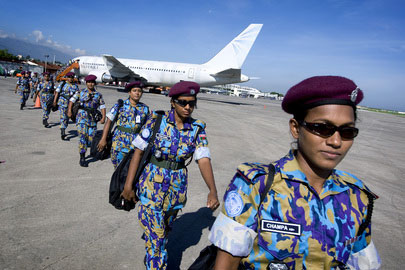
Bangladeshi All-Female Police Unit Arrives in Haiti An all-female Formed Police Unit from Bangladesh, serving with the United Nations Stabilization Mission in Haiti (MINUSTAH), arrives in Port-au-Prince to assist with post-earthquake reconstruction. The group, 110-women strong, is the second all-female contingent in any UN mission in the world. Source: UN Photo/Marco Dormino; 01 June 2010; Port-au-Prince, Haiti; Photo #438559 www.unmultimedia.org accessed September 2010. |
|
 |
|
Paton (Reading 9.2) describes the results of a comparative study involving a group of volunteers trained specifically to deal with large scale disasters and a group of fire fighters. Re-read the paragraph on page 143 beginning with "To test this idea…" for a refresher on what Paton's research involved. The results are presented in the form of three Tables. Examine these Tables and think about how you would write up these results if you were the researcher.
|
|
The following extract from EMA Recovery Manual 10, Chapter 13, Recovery Services, pp. 69-71 describes the key stressors facing disaster workers. Read through before commencing Video activity Japan Airlines Flight 123.
Workers’ Characteristics and Stresses
The requirements of workers involved in the provision of recovery services are closely related to the nature of the work likely to be encountered. Key stressors in disaster work include the following:
- its unpredictable, emergency nature;
- the need to provide services in an uncertain and rapidly changing environment;
- application of skills in an abnormal environment;
- high levels of both acute and ongoing stress;
- exposure to direct and vicarious trauma;
- highly charged personal work environment and sometimes brittle inter-agency relationships;
- exposure to intense emotions; and
- intense scrutiny of work performance (often by politicians and/or the media).
In addition to the skills required to provide specific services under normal circumstances, workers involved in service provision following an event need to be capable of dealing with these stressors. In choosing appropriate staff for recovery work, it may be useful to consider the following characteristics.
- Staff should have consolidated their core professional skills . A disaster is not a training ground for inexperienced workers.
- Staff should be secure in their professional identity , otherwise the uncertainty of the disaster situation and its consequent stresses may seriously undermine their confidence and capacity to deliver the relevant service.
- Staff should be secure in their role in their agency or organisation . The nature of recovery work necessitates time spent out in the field, away from the normal working environment. Workers cannot function effectively or provide the time required if they are anxious about their positions or feel that their agencies are ambivalent towards them being away. Work roles should permit a degree of flexibility.
- Staff need to adopt flexible working styles , and be prepared to improvise strategies for the delivery of services.
- Preparedness to travel and work out of hours in less than optimal conditions is also likely to be required.
Operational Checklist
Detailed below is a checklist of the key issues that will need to be addressed throughout the recovery process. The list is by no means exhaustive and, depending upon the nature and location of the event and the affected community, a range of other issues may also emerge.
- Liaise with relevant response agencies regarding location, size, type and potential impact of event.
- Contact and alert key staff.
- Determine likely human effects.
- Contact other relevant response and recovery agencies.
- Activate and brief relevant agency staff.
- Activate appropriate inter-agency liaison mechanisms.
- Locate liaison officer at emergency operations centre (if appropriate).
- Determine immediate short-term needs (e.g. accommodation, financial assistance and personal support).
- Manage offers of assistance, including volunteers, material aid and donated money.
- Assess impact of the event through information/data from local government, geographic data and relevant response agencies.
- Meet with other recovery agencies to determine strategies.
- Report to organisational hierarchy on likely costs/impact of involvement in recovery activities.
- Organise briefing and debriefing processes for staff.
- Activate outreach program to meet immediate needs and determine ongoing needs.
Issues to be considered should include the need for specialist counseling, material aid, accommodation, financial assistance and social, recreational and domestic facilities:
- Establish a ‘one-stop shop’ recovery centre to provide the affected community with access to all recovery services.
- Manage restoration of essential infrastructure/utilities.
- Manage the public appeal process.
- Brief media on the recovery program.
- Assess reports gathered through an outreach program to assess community needs.
- Identify special needs groups or individuals.
- Meet with other recovery agencies to consider full assessment of the impact of the event. Determine the best means of involving the affected community and determine action required from specific agencies.
- Activate community recovery committees, ensuring active participation of members of the affected community.
- Develop a community information process, including consideration of public meetings and newsletters.
- Monitor staffing arrangements.
- Review resources and services on an ongoing basis.
- Determine longer-term recovery measures.
- Provide newsletters to the affected community and information to the media as required.
- Provide interpreters, multilingual information and bilingual staff as necessary.
- Continue to monitor agency activities and reduce/withdraw services when appropriate.
- Debrief recovery agencies.
- Recognise agency/staff input.
(EMA Recovery, Manual 10, pp. 69-71)