
SOP - What are they, who needs them and who should prepare them?
As you can gather from the heading to this section, there are three key questions one could ask about SOP:
|
|
Let us look at these three questions in turn.
What are SOP?
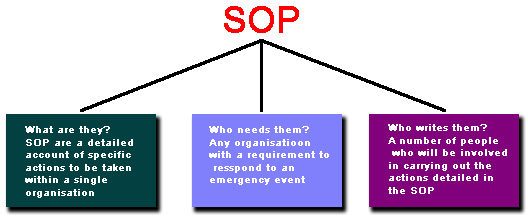
SOP are used in various ways by military, police and emergency service organisations to detail specific preplanned responses to identified emergency events. In our case, we are using SOP to detail our tactics to respond to the onset of the threat we identified in our hazard analysis and for which we produced an emergency plan.
A useful definition of a standard operating procedure is:

Who needs them?
The ‘single organisation’ can be any organisation required to respond to an emergency event. The emergency event can be external to the organisation, i.e. off-site in the case of a major bush fire, or internal, i.e. on-site in the case of an industrial accident.
Most of us think of organisations such as the Police, Fire Service, Ambulance Service, State Emergency Service and other emergency-related organisations when we talk about responding to an emergency. However, the need for an organised response to an emergency event applies to any organisation identified in the emergency management plan and can include local government, private industry and community groups, public agencies and even educational institutions.
The main concern with organisations from outside the emergency services is that they are not usually emergency response-orientated and greater emphasis needs to be placed on emergency management awareness and response training to achieve the level of required response action documented in a SOP.
Who should write SOP?
The strategy for writing SOP should be similar to that for producing an emergency plan, i.e. involving the people, or at least representatives of the people, who will be carrying out the actions detailed in the SOP.
There are two sound reasons for this:
- people involved in carrying out the actions in the SOP will have the technical skills and knowledge and will know what can and can not be done when and by whom;
- they will be more committed to the agreed actions if they have been involved in the writing of the SOP.
So, we can summarise our answers to the three key questions posed as follows:
 |
We have almost completed this section of the topic, so before proceeding let us summarise what we have learned so far and confirm our understanding of the material presented.
Activity 2.3
|
