Putting the plan into action
Having developed the strategy for managing an emergency event in your planning process, the next step is to detail the tactics that will be used to implement the plan’s actions when the emergency occurs. Essentially what we are going to be doing is putting the plan into action. Now let us have a look and see how we might achieve this.
The content of SOP
You will see as we progress through this topic that the detailed content of SOP will vary in accordance with the purpose for which they are being produced. However, all SOP should contain information related to the following questions. The answers to these questions will form the basis of our SOP.

|
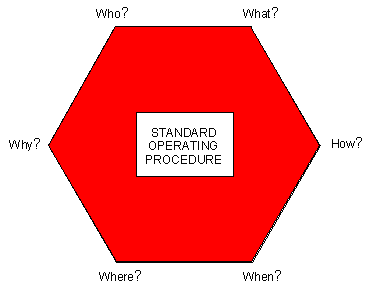
- WHO is going to do it ?
‘Who’ is the person or appointment that is going to do something.
- WHAT needs to be done?
‘What’ being the specific task that needs to be undertaken
to achieve the objective.
- HOW are they going to do it?
‘How’ being the detailed description of the behaviour that will achieve the ‘what’.
- WHEN are they going to do it?
‘When’ can be very critical to the efficiency of an emergency response. It may detail only one ‘trigger’ event or incorporate a sequence of events that can make the difference between success or failure.
- WHERE are they going to do it?
‘Where’ is the inclusion of location details for the undertaking of the task if this is relevant.
- WHY are they going to do it?
‘Why’ is a brief description of the purpose of the action/s so that the people involved understand the significance/urgency.
|
To help you remember these questions we can represent them as a hexagon.
 |
 |
Before we go on, carry out the following study
task, referring to the example SOP in Reading 5 and the one
you have obtained from an organisation in your local area.
- Examine each SOP and see whether you can identify and
list the components within them that relate to our hexagon.
It may assist you to do this in the form of a table as follows:
|
Example
SOP |
Local
area SOP |
|
Yes |
No |
How?* |
Yes |
No |
How?* |
Who |
|
|
|
|
|
|
What |
|
|
|
|
|
|
When |
|
|
|
|
|
|
Where |
|
|
|
|
|
|
How |
|
|
|
|
|
|
Why |
|
|
|
|
|
|
* Note: How? In this space
indicate how the information was displayed, for example,
was it in the form of a matrix (i.e. grid), was it in the form
of a job card (‘duty statement’) or aide-mémoire (‘reminder’
checklist/action sheet) or was it merely part of the text?
You will note that we have just introduced some new terminology,
e.g. ‘aide-mémoire’ and ‘job cards’ -
don't be concerned at this stage if you have difficulty in
understanding their meaning as we will be covering these in
more detail later in this section.
- Once you have completed the table, compare your results
for each of the SOP you have studied. Which one do you believe
best satisfies the requirement and why?
|
Print this activity
|
