
A process for producing SOP
As we discussed in the first section of this topic, the process of producing SOP is similar to that which we used to produce our plan. Essentially this revolves around involving other people from within the organisation for whom the SOP is being written.
We need to involve others in the process if we are to:
- gain their commitment to the finished SOP; and
- make maximum use of their general knowledge and technical expertise to ensure that the correct actions and their sequence are prescribed in the document.
Let us look at one possible sequential process for producing SOP.
We present here a five-step approach to developing the SOP:
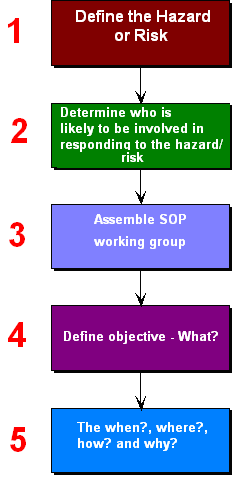 |
Figure 2.5: Five-step approach to developing the SOP |
Let us now consider each step in further detail.
Step 1: Define the hazard or risk
First we need to define the hazard or risk for which we are producing the SOP. This we should be able to do using our risk assessment/hazard analysis and the subsequent plan we prepared during the previous subject.
This could be something like one of the following: building fire, flooding of a town, or a major traffic accident.
Step 2: Determine who is likely to be involved in responding to the hazard
From a knowledge of your organisation and your involvement in the planning process you should be able to identify those people in the organisation likely to be involved in the response.
Activity 2.6
|

Now that we know who is involved we can move to the next step.
Step 3: Assemble SOP working group
Now you can assemble a group of people from within the organisation who can assist you in preparing your SOP. Remember that ideally you need to keep the group to a manageable number; for instance you would not involve all occupants of the building! On the other hand, you may see some advantage in involving the building commissar or receptionist as they might have some useful knowledge about visitor trends.
Having determined the who we now need to decide on the what.
Step 4: Define objective - what?
We now know who is likely to be involved in responding to a defined hazard. Now we need to determine what tasks/actions are likely to be required and which of our likely participants will carry them out.
Activity 2.7
|
 |
To demonstrate this step consider our building fire and make a list of the sort of tasks/actions that might be required and who will do them. It will help if you consider these sequentially; in the case of our fire, start with the initial alarm. A table is provided below in Activity 2.8 to assist you in compiling your list of actions required and those who are responsible for carrying out the actions.
For reflection Consider now what process you might use to determine the ‘what’ within the working group that you will form. For instance, you might think of issuing a questionnaire to the group identifying the hazard and then asking them to explain what they think they would need to do if an incident occurred. Alternatively you might be able to observe actual activities associated with the hazard/risk. |
If the hazard or risk is a technical one there may well be operator manuals that define what needs to be done in the event of an accident or specific occurrence.
It is recommended that any of these processes, and any other you can think of, be followed up with a meeting of the group so that individual responses can be discussed in open forum. This will allow for interface between all parties and will help ensure that nothing is overlooked.
Step 5: The when, where, how and why?
By using, within our working group, such methods as brain storming and questionnaires we can proceed to answer the remaining questions of when, where, how and why?
When? The sorts of answers that you could expect to this question include such things as: on discovering fire, on arriving at scene, when river height reaches x metres, when advised by floor wardens etc. Whilst some of these statements might appear to be very simplistic, all trigger events should be included to ensure timely and sequential action by the person/s involved. Remember the person reading the procedure may be a newcomer to the organisation and may not have had the opportunity to attend any training.
Where? In this part of our procedural matrix we might include such statements as: at accident scene, from the Emergency Operations Centre, at the assembly area, from the forward command post, etc. As indicated earlier in the topic, the ‘where’ only needs to be inserted where it is appropriate, as quite often the location at which an action will be carried out will be obvious. However it is advisable to include the heading in your matrix so that the question is not overlooked.
How? The ‘how’ is of course very much related to the ‘what’. The sorts of statement that might be relevant are as follows; by closing valve A, by telephone or radio, in person, by pressing alarm button B, by written report, etc. The ‘how’ tends to become very important when the ‘what’ requires some technical or physical action; e.g. closing or opening certain valves or other control devices. It is in these circumstances that having the right people on your SOP working group will be critical.
Why? What we are trying to avoid here is actions carried out merely by rote. If those involved realise the significance and importance of their actions it is more likely that the actions themselves will be carried out in a more timely and efficient manner. The sorts of answer you could expect include: to initiate building evacuation, to ensure all occupants safely evacuated, to keep all participants informed, to place people on standby, etc.
Activity 2.8
|
||||||||||||||||||||||||||