
Topic 10: Vulnerability & Resilience
Introduction
Chapter 9 of your McEntire textbook is a rather short chapter covering the topics of individual assistance, public assistance, important issues for recovery, and case studies illustrating the benefits of timely requests for increasing Emergency Management resourcing.
Read through the chapter carefully and complete the self-checks. Much of the information presented in first few pages relates to the United States. A handy glossary is provided at the end of the chapter. Most of the chapter is self-explanatory enough for those of us with an alternate cultural heritage to follow, however if you have an area of doubt put a question up onto the forum so that I can keep track of how valuable or not valuable using a text which requires a little bit of lateral application is. When you attempt the ‘Self-check’ dot points, try to answer according to your own locality, state or country.
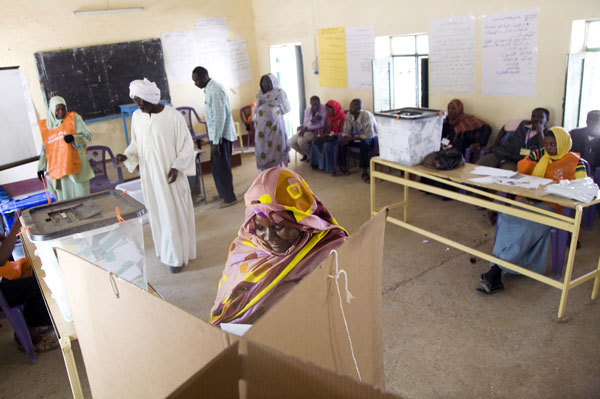
Woman Votes in Sudan's Extended Elections
A woman fills her ballot behind a cardboard partition at Ta'heel Tarabawi polling station in El Fasher, Sudan. Sudan's national elections, originally set from 11 to 13 April, have been extended by an additional two days.
Source: UN Photo/Albert Gonzalez Farran; 13 April 2010; El Fasher, Sudan; Photo #434001 www.unmultimedia.org accessed September 2010.
Defining vulnerability
Throughout this subject I have been making the point that the context helps define the terms you use. Here is a handy chart which ably demonstrates the myriad of ways ‘vulnerability’ can be interpreted and defined in relation to the context in which it is used.
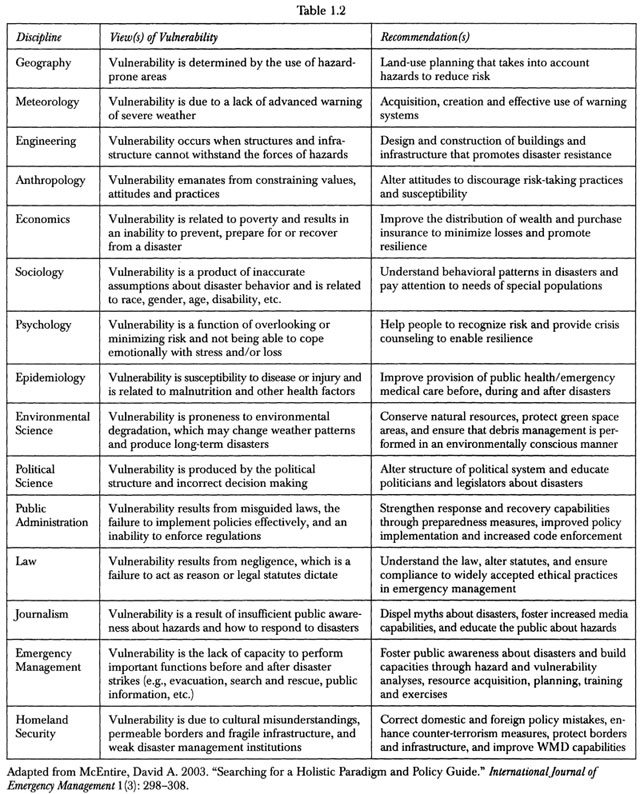
McEntire, D.A., (2007). The importance of multi- and interdisciplinary research on disasters and for emergency management. In D. McEntire (Ed.), Disciplines, disasters and emergency management (p. 6). Illinois: Charles C Thomas.
Vulnerability within the Emergency Management context has also been variously defined, for example:
- "Vulnerability is the degree of susceptibility and resilience of the community and environment to hazards."
(Emergency Management Australia, Manual 3: Glossary) - “Social systems generate unequal exposure to risk by making some people more prone to disaster than others and these inequalities are largely a function of the power relations (class, gender, age and ethnicity among others) operative in every society.”
Bankoff, G. The tale of the three pigs: Taking another look at vulnerability in the light of the Indian Ocean Tsunami and hurricane Katrina. http://understandingkatrina.ssrc.org/Bankoff/ accessed September 2010. - “By vulnerable we mean the characteristics of a person or a group in terms of their capacity to anticipate, cope with, resist and recover from the impact of a natural hazard. It involves a combination of factors that determine the degree to which someone’s life and livelihood are put at risk by a discrete and identifiable event in nature or in society.”
Blaikie, P., T. Cannon, I. Davis and B. Wisner, At Risk Natural Hazards, People’s Vulnerability and Disaster. London and New York: Routledge, 1994.
 |
|
|
McEntire Chapter 9 Go to bcs.wiley.com/he-bcs/Books?action=index&itemId=0471789747&bcsId=3306 and take the pre test for Chapter 9: Promoting Recovery and Mitigation to determine where you should concentrate your reading effort. Read through Chapter 9, working through the activities as you go. At the end of this topic take the online post test. |
|
|
|
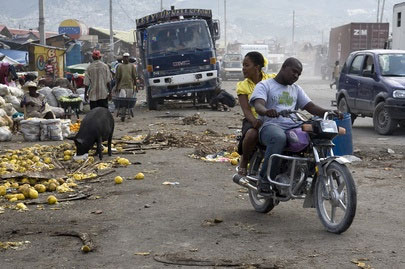
Port-au-Prince Market Revived Since Earthquake Port-au-Prince's Central Market shows its first signs of activity since the earthquake that struck Haiti on 12 January. Source: UN Photo/Pasqual Gorriz; 22 February 2010;Port-au-Prince, Haiti; Photo #429041 www.unmultimedia.org/photo/detail.jsp?id=429/429041 accessed September 2010. |
|