Topic 10: Vulnerability & Resilience
Case Study: Individual Assistance & Tropical Cyclone Larry, Queensland, 2006
In this section you will examine individual and public assistance using two case studies to complement the McEntire text.
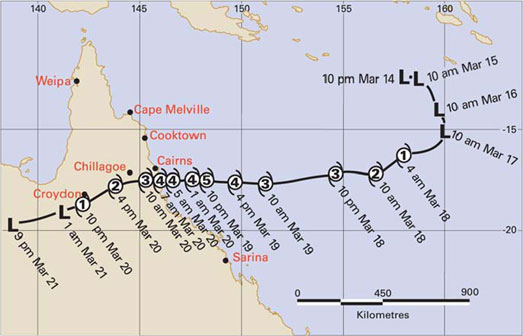
The following information is extracted primarily from the Queensland Government State Disaster Management Group and the Bureau of Meteorology. See the ‘further information’ section below for website details.
Severe Tropical Cyclone Larry (TC Larry) crossed the tropical north Queensland coast near Innisfail during the morning of the 20th March. It caused widespread major damage to homes and other buildings as well as extensive damage to local crops and industry.
TC Larry began as a low pressure system over the eastern Coral Sea. It formed into a tropical cyclone in the early hours of the 18th, and proceeded on an almost due westerly track towards the Queensland coast. TC Larry became a severe tropical cyclone at 10am on the 18th and continued to intensify as it approached the Queensland coast, reaching Category 4 early on the 19th. The eye of TC Larry crossed the coast near Innisfail between 6:20am and 7:20am on the 20th March. TC Larry started to weaken after it hit landfall but maintained cyclone strength for several hundred kilometres inland until the early hours of the 21st. Ex-tropical cyclone Larry moved into western Queensland to the north of Mount Isa.
Cyclone impact
Approximately 12,500 sq kms were affected by TC Larry and the subsequent flooding, from Mareeba in the North to Tully in the south and west to beyond Mt Garnet. Significant damage or disruption occurred to houses, businesses and industry, utilities, infrastructure (including road, rail and air transport systems, schools, hospitals and communications), crops and state forests. A 47 foot fishing vessel sank at Mission Bay, Yarrabah. TC Larry travelled almost 450 kms inland to around Croydon before being downgraded to a rain depression. The town of Innisfail was severely impacted and several communities were isolated for several days as a result of the flooding. A significant storm surge was caused by TC Larry, with sea levels exceeding the predicted tide by 1.75 metres at Clump Point, 1.76 metres at Cardwell and 1.54 metres at Mourilyan.
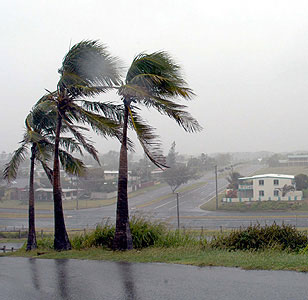
Cyclone Larry, Queensland, March 20th 2006
Source: http://www.gadr.giees.uncc.edu/hzeventdetails.cfm?ID=64 accessed November 2010.
Emergency Response
The Queensland Government undertook proactive pre-cyclone actions including warnings and advice to prepare the community for the onslaught of TC Larry. Government agencies, local councils, the State Emergency Service, energy suppliers and other organisations worked together to ensure a coordinated effort following the impact of the cyclone.
There was a significant emergency response to the impacted region by the Queensland emergency services and emergency management agencies including paid and volunteer personnel. There were also a large number of government agencies and non-government organisations involved in the response and recovery including Queensland Department of Communities for recovery aspects and Queensland Health for medical and health aspects. The Department of Primary Industry and Fisheries and the Department of State Development assisted businesses and industry to recover. As at 29 March, more than 3,800 people had been involved in the TC Cyclone response.
Emergency Management Australia’s (EMA) National Emergency Management Coordination Centre was activated to coordinate assistance to the Queensland Government to respond to and recover from the event, including coordinating Australian Defence Force (ADF) assistance and aerial surveillance of the damage by Customs and Australian Maritime aircraft. ADF assistance included reconnaissance, logistics, medical and engineering support tasks. EMA also coordinated the delivery of 15 tonnes of tarpaulins including ropes and other stores from the Australian Government Disaster Store.
EMA hosted daily Task Force situation reviews to Government of the cyclone’s impact and provided emergency management liaison officers to coordinate the Australian Government’s involvement in the impact zone.
Large quantities of resources were sourced including generators, tarps, chainsaws, fuel, earthmoving equipment, food and potable water. Every State Emergency Service tarp in Queensland was used which amounted to approximately 14,000 tarps. QANTAS provided 6000 in-flight meals to Innisfail.
Evacuation centres were established at Innisfail TAFE College, Silkwook School, Kurrimine Progress Hall, El Arish State School, Mission Beach Primary School. Mareeba had evacuation centres established at the PCYC and Merriland Centre. Red Cross managed the evacuation centre registration process.
Recovery coordination
Former chief of the ADF General Peter Cosgrove was appointed to lead the Queensland Government’s taskforce assigned to the long-term recovery and restoration effort for the cyclone affected communities.
The Department of Communities established Recovery Centres and mobile outreach services to provide emergency assistance to people facing genuine hardship and were aimed at financially assisting individuals and families with short term needs such as food, accommodation, medical supplies and clothing. Counselling was also provided.
The Australian Government activated a significant range of financial disaster assistance mechanisms, including personal, business and industry assistance schemes. See the Australian Government Disaster Assist website for further information.
For further information, visit the following websites:
- Queensland Department of Emergency Services - Operation Recovery www.operationrecovery.qld.gov.au/
- Queensland Government State Disaster Management Group www.disaster.qld.gov.au/
- Australian Government Disaster Assist www.disasterassist.gov.au
- Department of Primary Industries and Fisheries www.dpi.qld.gov.au
Source: extracted from EMA website http://www.ema.gov.au/ema/emadisasters.nsf/6a1bf6b4b60f6f05ca256d1200179a5b/b84244eb6226c1cfca2571840022ae82?OpenDocument accessed September 2010
Australian Government Assistance for those affected by Cyclone Larry. (This 5 page document is located on this CDROM as a pdf document).
Click here to view the form used to request individual assistance after Cyclone Larry: Request individual assistance (This form is also located on this CDROM as a pdf document).
 |
|
|
The Final Cyclone Larry Report is just over 200 pages and expresses the hope that it helps future Emergency Managers facing the recovery phases of a natural disaster. In particular read pages 1 to 23, which are written for people requiring a quick overview. |
|
 |
|
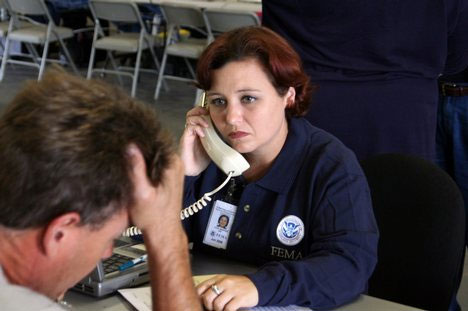
What do you think should be considered when opening up and running a disaster recovery centre? After considering your answers, go to Annex C (pages 64 and 65) of Reading 4.3 Recovery Management Directors Guidelines, to view the checklist for establishing a recovery centre.
Disaster Recovery Centre Source: http://cdn.wn.com/pd/bb/05/ae15c4837abf9b7a5c33012cdb09_grande.jpg accessed November 2010. |
|