
Topic 2: What is community?
The following three models will give you a further insight into how your definition of 'community' will affect your recovery management approach.
For instance, if you define your community in terms of its location, then you will construct recovery plans with the understanding that people in positions of power and expertise, such as council representatives, are the most likely ones to consult and liaise with.
If you understand the community from the perspective of social planning you will most likely lean towards a democratic problem solving approach, concentrating on social problems as a priority - as opposed to perhaps concentrating on the physical environment.
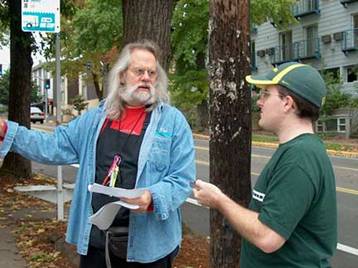
Robert Stevens (right), a graduate student in the "Applied GIS and Social Planning" class at the University of Oregon collects data with Drix, his neighbourhood partner and Chair of the West University Neighborhood Association.
In reality there may not be such a strict division as in the chart below, but at least you should get an idea of how defining 'community' leads to implications about hierarchies of importance in recovery management. Read the table from left to right, noting how each of the three ways of conceiving 'community' affects the response to the area of concern.
|
Area of concern |
Model A: |
Model B: |
Model C: |
1. |
Assumptions concerning community structure and problem conditions |
Community eclipsed, anomic; lack of relationships and democratic problem solving capacities; static traditional community |
Substantive social problems; mental and physical health |
Disadvantaged populations; social injustice; deprivation, inequity |
2. |
Basic change strategy |
Broad cross section of people involved in determining and solving their own problems. |
Fact-gathering about problems and decision on the most rational course of action |
Crystallisation of issues and organisation of people to take action against enemy targets |
3. |
Characteristic change tactics and techniques |
Consensus; communication among community groups and interests; group discussion. |
Consensus or conflict |
Conflict or contest; confrontation; direct action; negotiation |
4. |
Salient practitioner roles |
Enabler-catalyst. Coordinator; teacher of problem solving skills and ethical values |
Fact gatherer and analyst; program implementer; facilitator |
Activist-advocate; agitator; broker; negotiator partisan |
5. |
Medium of change |
Manipulation of small task-oriented groups |
Manipulation of formal organisations and of data |
Manipulation of mass organisations and political processes |
6. |
Orientation toward power structure(s) |
Members of power structure as collaborators in a common venture |
Power structure as employers and sponsors |
Power structure as external target of action; oppressors to be coerced or overturned |
7. |
Boundary definition of the community client system or constituency |
Total geographic community |
Total community or community segment (including "functional" community) |
Community segment |
8. |
Assumptions regarding interests of community subparts |
Common interests or reconcilable differences |
Interests reconcilable or in conflict |
Conflicting interests which are not easily reconcilable; scarce resources. |
Table 2.1: How defining 'community' leads to implications about hierarchies of importance in recovery management
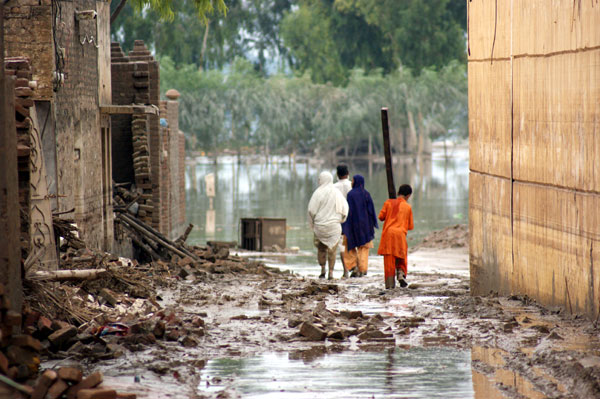
Pakistan Copes with Severe Floods
Victims of the worst floods to hit Pakistan in several years walk through water-filled streets in the northwestern city of Nowshera. The flooding caused by monsoon rains has claimed up to 1,400 lives and affected 2.5 million people, including Pakistan's large population of Afghan refugees.
Source: UN Photo/WFP/Amjad Jamal; 03 August 2010; Nowshera, Pakistan; Photo #442740; www.unmultimedia.org/photo accessed September 2010