
Topic 3: What happens to communities in disasters?
Communities in disaster
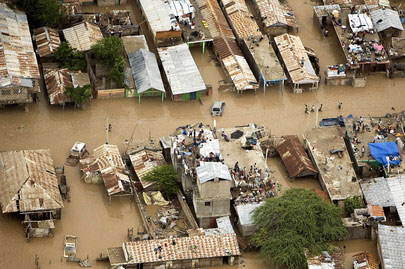
Tropical Storm Devastated Communities in Haiti
An Aerial view of the flooded houses in the aftermath of the tropical storm "Hanna."
Source: UN Photo/Marco Dormino; 03 September 2008; Gonaives, Haiti. Photo #191139. www.unmultimedia.org accessed September 2010
As previously discussed, there are many definitions of a community and many different perspectives regarding the criteria by which they may be defined. For the purposes of Emergency Management it is useful to define a community in terms of social bonds.
Communities comprise of people linked together by a complex framework of social bonds. These links may be through shared interests, sport, recreation, work, profession, family, religious beliefs and so on. People socialise and communicate via these bonds and they are the basis for the influence, history and tradition in a community. These connections hold the community structure together and each particular community has its own unique "fingerprint".
These bonds are not necessarily confined to a geographical region and may include people outside of a specific town, city or village.

When disaster events threaten a community, for example floods or bushfires, there will be warnings via the media. People tend to use their social network to seek confirmation of the warnings, in preference to consulting with the "experts". People may phone their families and friends within the affected region and from outside, seeking clarification and advice. The community's informal and formal plans and state of preparedness is now activated in readiness, or otherwise, for the particular event.
When disaster strikes, the pre-disaster structure is suspended as the need for survival is paramount. Regular pre-disaster bonds are not created for acute survival needs. In a disaster situation, people usually relate to those in need or those able to help them and those in their neighbourhood.
Social norms, such as not talking to strangers, are suspended, and replaced by camaraderie, altruism and cooperation, often with complete strangers. Social power structures have less influence, control and authority and chains of command become less significant. This process is known as "debonding". It does not occur at the same time or to the same extent for the whole community.
A noted authority on the bonding and debonding of communities experiencing a disaster is Rob Gordon. Read his article (Reading 3.1). A fuller version of his ideas is found in the Emergency Management Australia Recovery, Manual 10, in Appendix C on the Course Resources CD.
 |
|
|
Appendix C in Manual 10 Recovery Emergency Management Australia, accessed through your Course Resources CD or directly through the EMA website, further outlines Rob Gordon’s proposition of bonding and debonding. It is highly recommended reading. |
|