
Topic 1: Emergency Management Review
The framework of Emergency Management
Emergency Management is generally discussed using what is sometimes referred to as PPRR, that is, Prevention Preparedness, Response and Recovery. There are variations on this theme, with some organisations and countries opting to join Prevention and Preparedness into one category, and others changing the names included in cycle, for example in New Zealand it is Reduction, Readiness, Response and Recovery. Despite these differences in terminology there is a commonality regarding what each phase entails, and an underlying understanding that there is an overlap between when one phase begins and another ends.
Click on the components of the Emergency Management Framework for a brief definition.
| Prevention of an emergency
|
Preparedness for an emergency
|
| Response to an emergency
|
Recovery from an emergency
|
In many cases there is no clear distinction between the components of the Emergency Management framework. Basically the framework provides a useful tool to assess and analyse the overall needs of the community when subject to a traumatic event.
As you can see, most of the activities will have some effect on the recovery needs of a community; for example, public education, identified as a prevention activity, will have a considerable consequence on recovery.
This effect will be influenced by:
- how effectively the community has been educated to the potential of the emergency, and
- whether the community received education about the possible consequence of the emergency, and so on.
The following diagram illustrates the cyclic nature of the Emergency Management Framework.

Figure 1.2 The Emergency Management Cycle
Source: Marcie Beaudoin, EMG100 Assignment 2
You will have already realised that the four key elements referred to above cannot, and indeed must not, be regarded as separate parts. Each element will effect and be affected by the others. There is no clear distinction between the end of one phase and the commencement of the next. It is also not useful to think of them as sequential; these are not phases undertaken only after the preceding phase is finished. They are best described as different functions or aspects in which we are all involved, to different degrees at different times, both individually and overlapping.
 |
|
|
Why is it important not to view the response and recovery phases as distinctly separate? 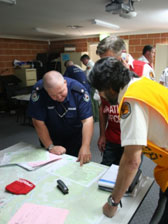
2009 Wingecarribee Gulp Road Fire Source: Matt Smith, Ben Shepherd and Anthony Clark. |
|