
Topic 1: Emergency Management Review
Definitions of terms used in Emergency Management
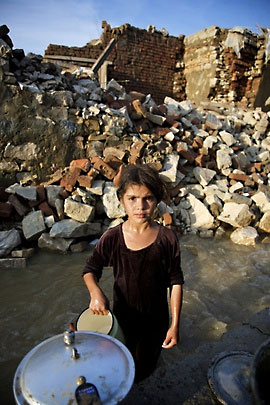
Northwest Pakistan Affected by Heavy Floods Eight-year-old Amreen washes dishes in rainwater, in Khwas Koorona Village in the northwestern Khyber-Pakhtunkhwa province of Pakistan. A destroyed house stands behind her. An estimated 2.5 million of the province's 3.5 million residents have been affected by severe floods. Source: UN Photo/UNICEF/ZAK; 04 August 2010; Khwas Koorona, Pakistan www.unmultimedia.org; |
The situation in which we use certain terms influences the way these terms are defined and understood. For example, the word ‘emergency’ is variously defined according to the field in which it is applied. It may mean something slightly different, or have a variation on emphasis, when used within a social welfare situation where you are dealing with a homeless family, as opposed to an emergency services context, where you are surveying a town threatened by rising flood waters. I have provided a number of definitions below to illustrate this point. It is very important that you develop a working definition and understanding which reflects your own context. An emergency from an emergency services perspective A serious disruption to community life which threatens or causes death or injury in that community and/or damage to property which is beyond the day-today capacity of the prescribed statutory authorities and which requires special mobilisation and organisation of resources other than those normally available to those authorities. Reading between the lines I hope you are able to see that an ‘emergency’ for the emergency services is a situation in which local resources will not suffice, and extra help from neighbouring agencies will need to be called in. An emergency from a sociological perspective An emergency may be defined as the interface between an extreme event and a vulnerable human population. In Emergency Management we generally refer to an ‘emergency’ as an event whose impact would require a significantly higher level of management than could otherwise be provided by a single agency in response to a lesser event e.g., a minor traffic accident or building fire which would be well within the resources of the single emergency service agency or local community. The Australian Emergency Management Glossary (Manual 3 on your Course Resources CD ROM) contains a number of definitions for emergency, additional to those above. Refer to those definitions in order to identify similarities between definitions from different sources. |
 |
|
Defining Emergency and Disaster The McEntire textbook we are using was written in the United States and reflects a slightly different perspective when it comes to defining disaster and emergency to the definitions we have been providing from Australian sources. How does McEntire define disaster? Disaster: Emergency: A minor event that can cause a few casualties and a limited amount of property damage or an imminent event that requires prompt and effective action. This definition of emergency is located in the same Disaster Management series as your McEntire text. The reference for it is: Lindel, M. K., Prater, C. & Perry, R. W. (2007). Introduction to Emergency Management (p. 15). USA: Wiley. Comparison of definitions How do these definitions compare with your own thinking? It is important to note there is no ‘right’ or ‘wrong’ answer here; it is a matter of how useful the definition is to you within your context, and what you find is the most applicable. Understanding the debate about definitions is important because you will constantly come across variations within Emergency Management literature, and you will need to be able to adjust to each locality, organisation or author’s understanding. |
|