
Topic 1: Emergency Management Review
Relationship between Recovery Management and Risk Management
As previously stated, it is important to understand that the components referred to within the Emergency Management framework cannot, and indeed must not, be regarded as separate parts. Each component will effect and be affected by the others.
The most appropriate starting point when discussing the relationship between Recovery Management and Risk Management is the way we define risk. Write down in your own words your understanding of risk. Don’t go to the dictionary just yet; put your knowledge into your own words. It is a good test of the depth of your current understanding.
 |
|
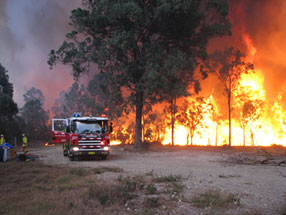
Cranebrook, NSW, 12th December 2006
Source: Photo by Mick Medlin,
www.rfs.nsw.gov.au/dsp_content.cfm?cat_id=880
accessed September 2010.
There are a number of ways to define risk, usually contingent upon organisational perspective. Read through the following definitions and compare them with your own definition.
Risk is:
- “a concept used to describe the likelihood of a consequence arising from a set of circumstances” (EMA Glossary, Manual 3)
- A risk is defined by the Australia/New Zealand Standard for Risk Management (AS/NZS ISO 31000:2009) as “…the possibility of something happening that impacts on your objectives. It is the chance to either make a gain or a loss. It is measured in terms of likelihood and consequence.”
- The expected losses (of lives, persons injured, property damaged, and economic activity disrupted) due to a particular hazard for a given area and reference period. Based on mathematical calculations, risk is the product of hazard and vulnerability (United Nations Department of Humanitarian Affairs, 1992, Internationally Agreed Glossary of Basic Terms Related to Disaster Management, Geneva).
- "The probability of harmful consequences or expected losses resulting from a given hazard to a given element at danger or peril over a specified time period." Source: Schneiderbauer, S. & Ehrlich, D. (2004): Risk, hazard and people’s vulnerability to natural hazards. A review of definitions, concepts and data. European Commission Joint Research Centre. EUR 21410 EN. 40 pp.
- Defined as the likelihood, or more formally the probability, that a particular level of loss will be sustained by a given series of elements as a result of a given level of hazard. The elements at risk consists of populations, communities , the built environment, the natural environment, economic activities and services, which are under threat of disaster in a given area." Alexander, D. (2000): Confronting Catastrophe - New Perspectives on Natural Disasters. Oxford: Oxford University Press. pp.282.
If you are interested in more definitions of risk, check out the following disaster terminology website: www.ehs.unu.edu/moodle/mod/glossary/view.php?id=1