
Section 5: Development and conduct of training
Introduction
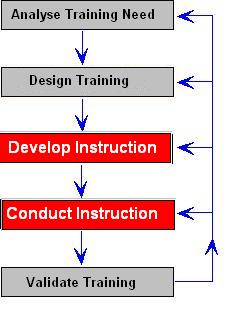
In Section 4 we covered the Design of Training and produced training objectives
and tests based on the job and task analysis we had conducted earlier. What
we now have is a number of training objectives at terminal, enabling and
instructional level, some or all of which will need to be presented to the
trainees in a course of instruction. We have completed the analyse and design
phases and we will now look at the development and conduct of training.
 |
Our next task, therefore, must be to examine the information we already
have and process it into a course package ready for delivery to the trainee
group.
It is not our intention in this guide to try and teach you the details of methods of instruction; as this would require a whole subject – or even course - in its own right. Rather we will try and give you the knowledge, skills and attitudes to begin to develop course material and to understand the ways in which you can prepare to conduct the training. Therefore in this topic we will be considering the factors involved in the preparation of topic plan material, the types of training that can be used and the preparation of a training program.
Planning considerations
As in all forms of planning the development of training programs requires that we take a number of considerations into account.
The following reading refers back to training analysis and design and states that training objectives represent the goals of a training program. During our consideration of the writing of training objectives we determined that it was likely that there would be a number of training objectives at all levels that we would need to cover in some way if the trainees were to be competent.
In other words we need to develop some plan to encompass all of our training requirements; this can be in the form of a long term (annual etc.) training program consisting of a number of training courses or simply one training course. Whilst we will not be looking at the preparation of an annual training program in any detail, have a quick read of paragraph 6.06 of the Australian emergency manual: Training management, and Figure 6.2. contained in Reading 14.
Note that some of these considerations can apply to the preparation of a course as well as a longer term program.
Activity 3.12
|
 |
ReadReading 14: Extracts from Australian emergency manual: Training management, Chapter 6, paragraphs 6.02 - 6.05.
Reading 14: Extracts from Australian emergency manual: Training management, Chapter 7, paragraphs 7.01 - 7.09 and Figure 7.2. |