
Section 4: Design of training
In Section 3 we covered the conduct of a training needs analysis based on our SOP. You will have identified that there are people within the organisation for whom you wrote your SOP that require training if they are to be able to carry out the roles and tasks required of them.
We can assume that in order to achieve the performance results we expect from these people we must provide them with certain knowledge and skills. The problem we have is how best to clearly identify and ‘list’ the trainees post-training performance, the standard of that performance and the conditions under which it will be carried out.
The easiest way to achieve this is to prepare statements containing this information that are referred to as training objectives.
The other thing that we will need to be able to do is to satisfy ourselves that the trainees are able to achieve the performances we require before we certify that they are competent. In order to do this we must be able to design and develop tests that are relevant to the desired training outcome.
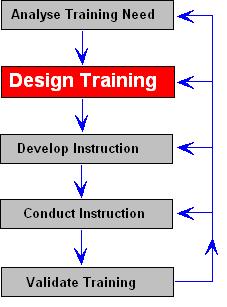
In this topic we will be examining the design of training which involves
writing training objectives and the design and development of tests.
 |
During job analysis we identified, amongst other things, the conditions under which each task is performed and the standards of work required. By listing what the person, or team, actually does we have identified something we can observe. With the addition of some standards to this observable performance we can measure, or test, competence.
Keep these issues in mind as we now look to determine a way in which we can display this information in a style which can be readily understood by the trainer and more importantly the trainee, namely, training objectives.
Writing training objectives
This section is divided into three parts:
- What are training objectives and why do we need them?
- The characteristics and types of objectives.
- Applying the principles - writing training objectives.
What are training objectives and why do we need them?
Training objectives can be defined as:
- descriptions of performances we want trainees to be able to carry out as a result of training before we can consider them competent.
We need some way in which we can encapsulate the information we gathered during the job and task analysis process into a document that is of maximum benefit to those involved in the management, design and delivery of training as well as the trainees. Training objectives are a simple, logical and well proven way in which to achieve this aim.
There are several important factors that you should know about training objectives:
- they describe what the trainee will be able to do;
- they relate to the end result of training;
- trainees should be able to do something that they could not do before the training;
- the performance/change of behaviour must be observable; and
- the standard of the performance/extent of the change of behaviour must be measurable.
There are several advantages to having well constructed training objectives. If your training objectives are clear then:
- trainees will know exactly what is expected from them as a result of the training;
- trainers will have clear statements of what is expected to be achieved as a result of the training they carry out;
- you will have a sound basis for the selection of instructional content, material and method;
- you will have a strong primary basis for the development of tests/assessments;
- management will have clear statements identifying training outcomes; and,
- in some circumstances training objectives can be used to validate existing performance standards.
Activity 3.6
|
 |
ReadReading 14: Extracts from Australian emergency manual: Training management, Chapter 4, paragraphs 4.01 to 4.06. The following web links are also useful: http://www.johngedeon.com/ObjectivesWriting.ppt http://www.arl.org/training/ilcso/objectives.html http://www.arl.org/training/ilcso/index.html You will have noticed that I have provided a definition of
training objectives in this topic that differs slightly from
that presented |
Characteristics and types of training objectives
A consideration of the characteristics and types of training objectives will provide us with the final ingredient that will enable the writing of objectives for the training needs identified in Section 2.
There are three types of training objective. They are:
terminal objectives |
what a trainee must be able to do at the end of the course; note that one course may contain a number of terminal objectives;
|
enabling objectives; |
what trainees need to know or do to be able to achieve a terminal objective
|
instructional objectives. |
what the trainee must be able to do or know after a period of instruction |
Activity 3.7
|