
Applying the principles - writing training objectives
Now that we have examined the principles we can start to write training objectives for our own purposes. What we need to do now is to relate what we identified as a result of our job and task analysis during Section 2 and relate these to the different types of training objective: terminal, enabling and instructional.
In Section 2 you had developed your SOP and considered a particular appointment or job, i.e. Council Engineer, Police Inspector in Charge etc. You identified that this appointment had some major responsibilities related to the hazard, i.e. coordinate evacuation, control emergency services at an accident scene etc. For our purposes we decided that these responsibilities could be referred to as duties.
These duties could then be further broken down into tasks and task steps, which in turn required certain knowledge, skills and attitudes
For our purposes, the best way of relating the structure of a job to our hierarchy of training objectives is to use the following simple correlation:
The structure of a job |
Training objectives hierarchy |
Duty |
Terminal objective |
Task |
Enabling objective |
Task step |
Instructional objective |
Training objective hierarchy
Let us now work through an example together using one of the SOP example readings we used in Topic 2.
Activity 3.8
|
 |
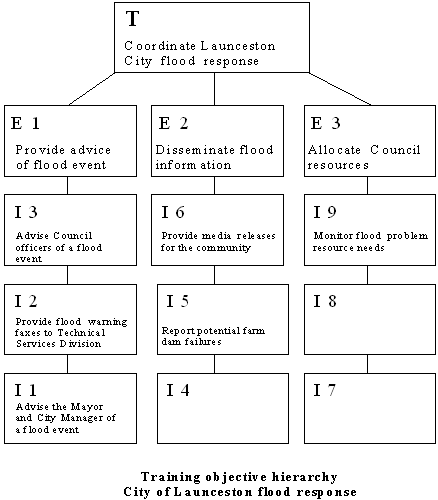
ReadReading 5: Standard operating procedure: Flash flooding and river floods. Paragraph 3, p. 1. Duty Card No. 1, p. 16. The first thing we have to decide is the appointment/job we will consider. As you will have noted from paragraph 3 of the reading there are ten appointments that have been identified as potentially carrying out the responsibilities/duties of the City of Launceston Flood Coordinator. All of these appointments obviously have a number of responsibilities, only one of which is the coordination of flood response activities. Therefore it is probable that they will all need at least some training in flood response as it is not a normal day to day activity. For the purposes of our exercise we will take the job of the Engineering Manager, Works and assume that he has been delegated as the Flood Coordinator. We start by writing the terminal objective box of the training objective hierarchy in relation to this job by writing the duty as an action statement. A measurable action such as; ‘Coordinate the City of Launceston flood response’ is appropriate in this situation. Remember that we need to list activities that can be seen and that together with a set of standards can be measured. There are other words which will meet this requirement in this case but ‘flood coordinator’ does not suffice. The next step we need to take is to identify some of the tasks or enabling objectives that we must cover in our training if the person/trainee is to be competent after training to perform the duty.
A training objectives hierarchy for this situation would look like this:
These are fairly simplistic instructional objectives and have been used merely to demonstrate a process. You might decide that for instance instructional objectives 1 to 3 can all be covered under the enabling objective E1. This is acceptable as long as you don’t overlook any element/sub-task. The final step in the process that we need to consider is what knowledge, skills and attitudes do we need to provide the trainees? Again using our example this may be a fairly simplistic exercise but it will help demonstrate the process. Let us take instructional objective I6: Provide media releases for the community.
|
The training objective matrix
We have now completed the ‘what’ or performance part of the process. The next step when we will identify the conditions and standards under which the objectives are to be performed. Let’s now look at completing our individual training objectives using the above examples. For ease of understanding by the trainee and simplicity of preparation by the trainer, we can use the following training objectives table/matrix or format.
Performance |
Conditions |
Standards |
Remarks |
|
|
|
|
|
|
|
|
Training objective matrix |
Activity 3.9
|
|
ReadReading 14: Extracts from Australian emergency manual: Training management, Chapter 4, paragraph 4.16 and Figure 4.2.
View the above video ‘training objective matrix’.
|
Assignment Activity
You may wish to continue your assignment work by now developing the training objectives related to your own Training Needs Analysis. See the Assignment Guide for further information.